

Dynamic Host Configuration Protocol for IPv6 (DHCPv6) is used to assign IPv6 addresses statefully and distribute other configuration information such as domain name or DNS server.
When creating a DHCPv6 pool, the user needs to assign a prefix to client DUID.
DUID is used to identify the client's unique duid value. The format is xx:xx:xx:xx:xx:xx. RFC3315 defines three types:
- Link-layer address plus time:
- 00:01:hardware type:time:link-layer address
- Hardware type - 16 bit hardware type reserved by IANA. 1 means an Ethernet device.
- Time: 32-bit unsigned integer. The time in seconds when this DUID was generated since 00:00:00 1/1/2000.
- Link-layer address - The link layer address of a device generating the DUID.
- Vendor-assigned unique ID based on Enterprise Number:
- 00:02:enterprise-number:identifier
- Enterprise-number - 32-bit integer reserved by IANA.
- Identifier - Variable length data for each vendor
- Link-layer address:
- 00:03:hardware type:link-layer address
- Hardware type - 16 bit hardware type reserved by IANA. 1 means an Ethernet device.
- Link-layer address - The link layer address of a device generating the DUID.
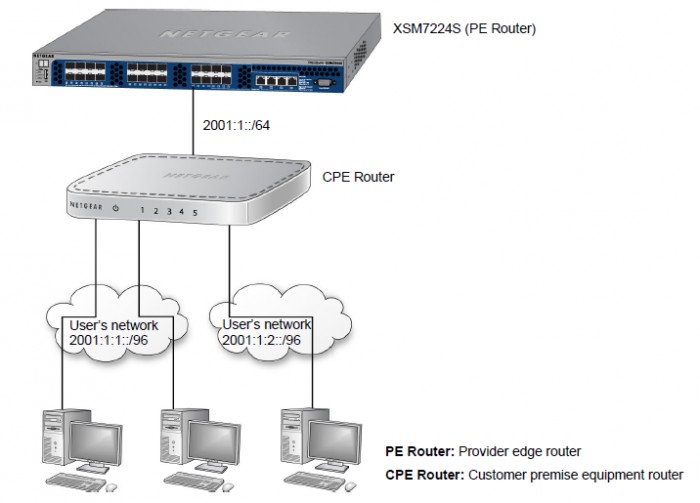
In the following case, the CPE router requests prefix from the PE router. The PE router chooses prefix (2001:1::/64) for delegation, and responds with the prefix to the requesting CPE router. The CPE router subnets the prefix and assigns the longer prefixes to links in the user’s network. The CPE router is then responsible to assign the 2001:1:1::/96 to one user’s network and 2001:1:2::/96 to another user’s network.
For more information, see the following support articles:
- How do I configure Dynamic Host Configuration Protocol for IPv6 (DHCPv6) using CLI commands on my managed switch?
- How do I configure an inter-area router and Dynamic Host Configuration Protocol for IPv6 (DHCPv6) using the web interface on my managed switch?
- How do I configure a stateless DNS server using CLI commands on my managed switch?
- How do I configure the stateless Dynamic Host Configuration Protocol for IPv6 (DHCPv6) using the web interface on my managed switch?