

The following sample scenario consists of an advanced network with a wireless controller, PoE switch, Layer 3 switch or router, access points, and several VLANs and SSIDs. The wireless controller system includes the following VLANs:
- VLAN 1, the default untagged VLAN to access the wireless controller
- VLAN 10, a tagged client VLAN
- VLAN 20, another tagged client VLAN
- VLAN 100, a tagged management VLAN
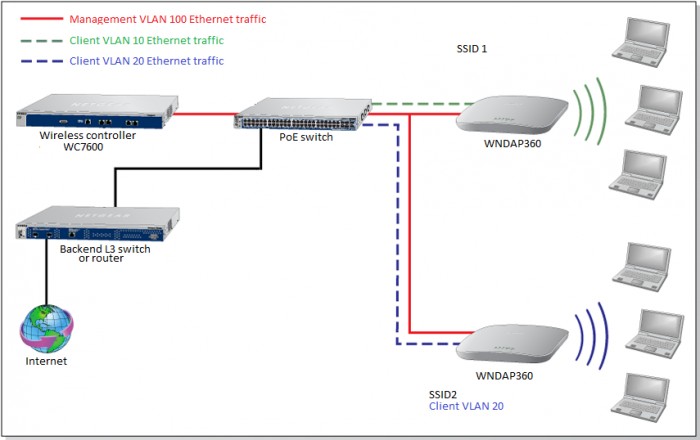
The access points and wireless controller are connected in the same subnet and same VLAN and use the same IP address range that is assigned for that subnet. The configuration does not include any routers between the access points and the wireless controller. The access points are connected to a PoE switch, which, in turn, is connected to the Layer 3 switch or router that provides Internet access.
This network configuration has the following prerequisites:
- VLANs 10, 20, and 100 are tagged VLANs and are configured on the wireless controller and the PoE switch.
- The wireless controller is connected to the PoE switch through default VLAN 1. You manage the wireless controller from a computer over VLAN 1 through the PoE switch.
- The DHCP server on the wireless controller is configured in management VLAN 100 to enable the access points to receive an IP address through VLAN 100.
- The PoE switch port to which the wireless controller is connected is configured as a tagged port to allow tagged traffic from VLAN 100.
To provision the wireless controller:
| Step | Configuration | Web management interface path |
| 1. | Configure the basic system settings: | |
| 1. Configure the country code of operation. | Configuration > System > General | |
| 2. Configure the time settings. | Configuration > System > Time | |
| 3. Configure the IP address of wireless controller. | Configuration > System > IP/VLAN | |
|
4. For initial discovery and configuration of the access points, temporarily configure management VLAN 100 as an |
||
| 5. Change default VLAN 1 to a tagged VLAN. | ||
| 2. | For initial discovery and configuration of the access points, temporarily configure management VLAN 100 as an untagged management on the PoE switch. |
|
| 3. | Configure either the network’s DHCP server or the wireless controller’s DHCP server to use VLAN 100. If you use the wireless controller’s DHCP server: |
|
| 1. Configure the IP address range for VLAN 100. | Configuration > System > DHCP Server | |
| 2. Configure the other DHCP server fields, including the gateway and DNS servers. |
||
| 4. | Configure the following profiles, and configure network authentication and data encryption for these profiles: |
|
| 1. A profile with SSID 1 and VLAN 10. | Configuration > Profile > Basic | |
| 2. A profile with SSID 2 and VLAN 20. | ||
| 3. If necessary for the selected network authentication options, configure one or more authentication servers. |
Configuration > Security > Basic > Authentication Server | |
| 5. | Connect the wireless controller to the PoE switch. | |
| 6. | Before you connect the access points to the PoE switch, verify that the switch ports to which you intend to connect the access points are configured as access ports in management VLAN 100. |
|
| 7. | Deploy the access points and connect them to the designated PoE switch ports. |
|
| 8. | When the access points are operating, open the Discovery Wizard to do the following: |
Access Point > Discovery Wizard |
| 1. Specify the state of the access points, which is factory default in a Layer 2 network. |
||
| 2. Run the Discovery Wizard. | ||
| 3. Select the access points that you want the wireless controller to manage and add them to the managed list. Note: By adding the access points to managed list, you enable them to receive an IP address from the DHCP server over management VLAN 100. |
||
| 9. |
For each access point on the managed list, disable the untagged |
|
| 10. | Restore connectivity between the access points and the wireless controller by changing the PoE switch ports to which the access points are connected to tagged ports. During the discovery process, these switch ports were access ports in management VLAN 100. |