

The word "bridge" is used in two senses:
- It describes connecting two parts of a wireless network separated by a distance. For example, a WGE101 wireless bridge could be used to connect a gaming console in a remote bedroom to the main part of the network. This technique is useful even in small networks.
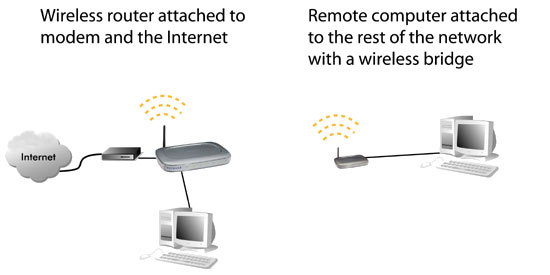
The advantage to a wireless bridge (instead of an adapter in the remote computer) is greater power, which means greater distance and better throughput.
Repeating is similar to bridging, it's more flexible, but may be harder to configure. Comparing bridging, repeating, point-to-point, and point-to-mutipoint
-
Bridging, more generally, describes the connection between two parts of a network where it isn't necessary or desirable for every computer on the network to send its traffic to every other computer. That is, it's a way to avoid distributing traffic too widely, especially across long distances, or to inappropriate computers. This kind of bridging is suited for more experienced users, in larger networks. Wireless bridging overview
N101533.asp Aug. 26, 2005