

The DVMRP is used for multicasting over IP networks without routing protocols to support multicast. The DVMRP is based on the RIP protocol but more complicated than RIP. DVRMP maintains a link-state database to keep track of the return paths to the source of multicast packages.
The DVMRP operates as follows:
- The first message for any source-group pair is forwarded to the entire multicast network, with respect to the time-to-live (TTL) of the packet.
- TTL restricts the area to be flooded by the message.
- All the leaf routers that do not have members on directly attached subnetworks send back prune messages to the upstream router.
- The branch that transmitted a prune message is deleted from the delivery tree.
- The delivery tree, which is spanning to all the members in the multicast group, is constructed.
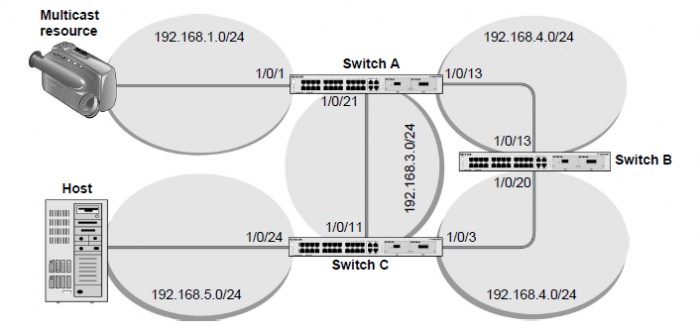
In the figure below, DVMRP is running on switches A, B, and C. IGMP is also running on Switch C, which is connected to the host directly. After the host sends an IGMP report to switch C, multicast streams are sent from the multicast resource to the host along the path built by DVMRP.
For more information, see the following support articles:
This article applies to the following managed switches and their respective firmware:
- M5300 - firmware version 10.0.0.x
-
- M5300-28G (GSM7228S)
- M5300-5G (GSM7252S)
- M5300-28G3 (GSM7328Sv2h2)
- M5300-52G3 (GSM7352Sv2h2)
- M5300-28G_POE+ (GSM7228PSv1h2)
- M5300-52G-POE+ (GSM7252PSv1h2)
- M5300-28GF3 (GSM7328FSv2)
- XSM7224S - firmware version 9.0.1.x (license required to support the feature described in this article)
Last Updated:07/07/2025
|
Article ID: 22000