

This example shows how to configure your managed switch to support VRRP. Router 1 is the default master router for the virtual route, and Router 2 is the backup router.
- Enable IP routing on the switch.
- Select Routing > IP > Basic > IP Configuration.
A screen similar to the following displays.
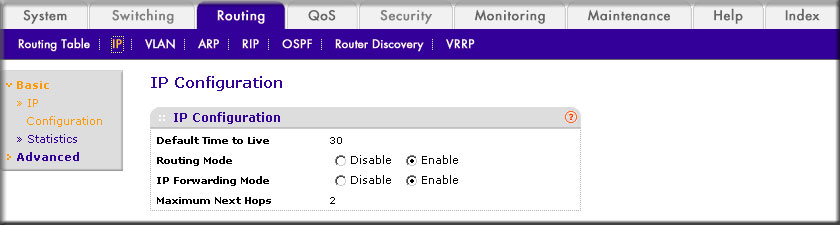
- For Routing Mode, select the Enable radio button.
- Click Apply to save the settings.
- Select Routing > IP > Basic > IP Configuration.
- Assign the IP address 192.150.2.1 to port 1/0/2:
- Select Routing > IP > Advanced > IP Interface Configuration.
A screen similar to the following displays.
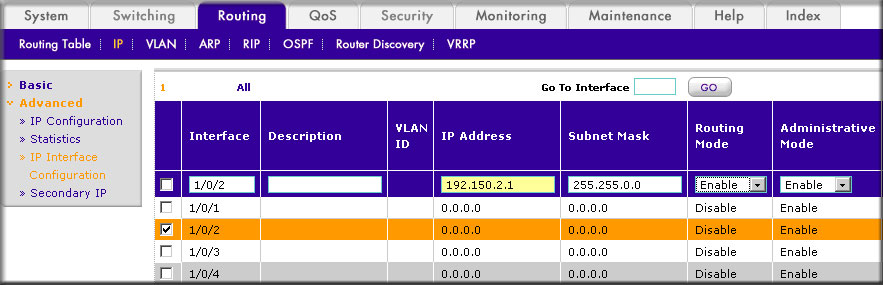
- Scroll down and select the Interface 1/0/2 check box.
Now 1/0/2 appears in the Interface field at the top.
- Enter the following information:
- In the IP Address field, enter 192.150.2.1.
- In the Network Mask field, enter 255.255.0.0.
- In the Routing Mode field, select Enable.
- Click Apply to save the settings.
- Select Routing > IP > Advanced > IP Interface Configuration.
- Enable VRRP on port 1/0/2.
- Select Routing > VRRP > Advanced > VRRP Configuration.
A screen similar to the following displays.
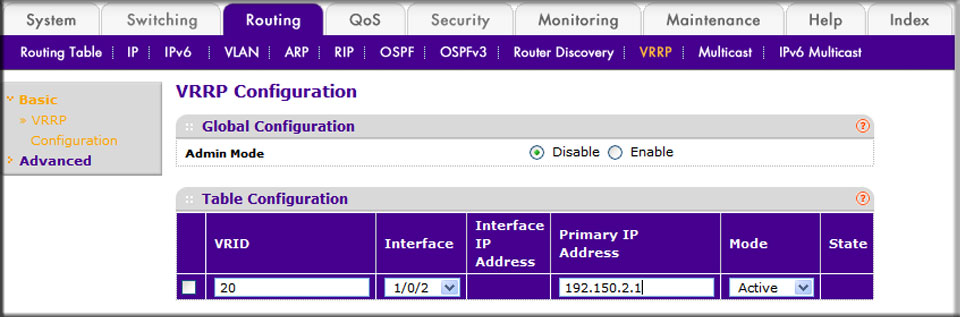
- Under Global Configuration, next to the Admin Mode, select Enable radio button.
- Enter the following information in the VRRP Configuration:
- In the VRID (1 to 255) field, enter 20.
- In the Interface field, select 1/0/2.
- In the Primary IP Address field, enter 192.150.2.1.
- In the Mode field, select Active.
- Click Apply to save the settings.
- Select Routing > VRRP > Advanced > VRRP Configuration.
For more information, see the following support articles:
- What is the Virtual Router Redundancy Protocol (VRRP) and how does it work on my managed switch?
- How do I configure the Virtual Router Redundancy Protocol (VRRP) on a master router using CLI commands on my managed switch?
- How do I configure the Virtual Router Redundancy Protocol (VRRP) on a backup router using CLI commands on my managed switch?
- How do I configure the Virtual Router Redundancy Protocol (VRRP) on a backup router using the web interface on my managed switch?
This article applies to the following managed switches and their respective firmware:
- M5300 - firmware version 10.0.0.x
-
- M5300-28G (GSM7228S)
- M5300-5G (GSM7252S)
- M5300-28G3 (GSM7328Sv2h2)
- M5300-52G3 (GSM7352Sv2h2)
- M5300-28G_POE+ (GSM7228PSv1h2)
- M5300-52G-POE+ (GSM7252PSv1h2)
- M5300-28GF3 (GSM7328FSv2)
- XSM7224S - firmware version 9.0.1.x (license required to support the feature described in this article)
Last Updated:07/07/2025
|
Article ID: 21705