

When an end station is statically configured with the address of the router that will handle its routed traffic, a single point of failure is introduced into the network. If the router goes down, the end station is unable to communicate. Since static configuration is a convenient way to assign router addresses, Virtual Router Redundancy Protocol (VRRP) was developed to provide a backup mechanism.
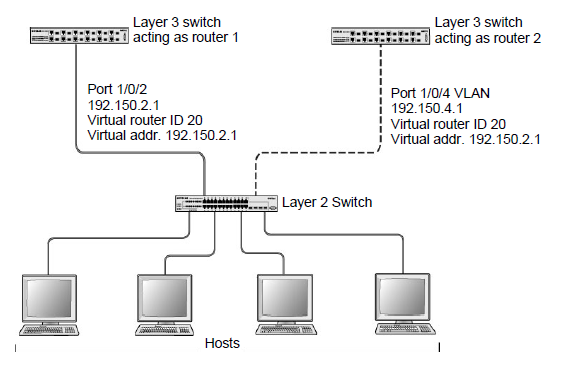
VRRP eliminates the single point of failure associated with static default routes by enabling a backup router to take over from a master router without affecting the end stations using the route. The end stations use a virtual IP address that is recognized by the backup router if the master router fails. Participating routers use an election protocol to determine which router is the master router at any given time. A given port could appear as more than one virtual router to the network. Also, more than one port on a M5300 or XSM7224S managed switch can be configured as a virtual router. Either a physical port or a routed VLAN can participate.
For more information, see the following support articles:
- How do I configure the Virtual Router Redundancy Protocol (VRRP) on a master router using CLI commands on my managed switch?
- How do I configure the Virtual Router Redundancy Protocol (VRRP) on a master router using the web interface on my managed switch?
- How do I configure the Virtual Router Redundancy Protocol (VRRP) on a backup router using CLI commands on my managed switch?
- How do I configure the Virtual Router Redundancy Protocol (VRRP) on a backup router using the web interface on my managed switch?
This article applies to the following managed switches and their respective firmware:
- M5300 - firmware version 10.0.0.x
-
- M5300-28G (GSM7228S)
- M5300-5G (GSM7252S)
- M5300-28G3 (GSM7328Sv2h2)
- M5300-52G3 (GSM7352Sv2h2)
- M5300-28G_POE+ (GSM7228PSv1h2)
- M5300-52G-POE+ (GSM7252PSv1h2)
- M5300-28GF3 (GSM7328FSv2)
- XSM7224S - firmware version 9.0.1.x (license required to support the feature described in this article)