

Power over Ethernet (PoE) is a feature that lets a network device such as a VoIP phone, access point, or IP camera receive its electrical power over the same Ethernet cable that connects it to the network. This feature lets the network device function without a power supply that is plugged into an electrical outlet. A power sourcing equipment (PSE) is a device such as an Ethernet switch with PoE capability (that is, a PoE switch) that delivers power to a powered device (PD) such as a VoIP phone, access point, or IP camera.
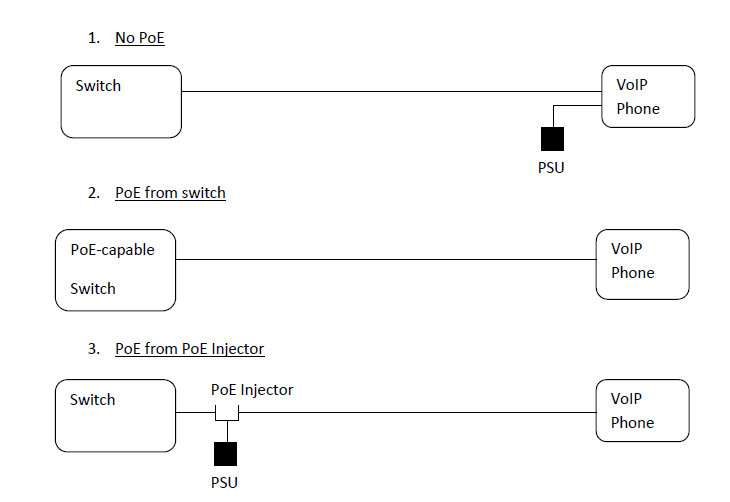
PoE power can be supplied from a PoE switch or from a power supply that is connected to a PoE "injector" that can be connected along the Ethernet cable. A PoE switch can supply PoE power to multiple PDs, but a power injector generally supplies PoE power to a single PD.
The following illustrates different methods to power up a VoIP phone.
PoE and PoE standards
PoE is a networking feature defined by the IEEE 802.3af (PoE), IEEE 802.3at (PoE+), and IEEE 802.3bt (PoE++) standards.
PoE (as a general standard, not referring to 802.3af only) lets Ethernet cables supply power to network devices over the existing data connection. If your PoE switch supports IEEE 802.3bt, it can supply power to 802.3bt, 802.3at, and 802.3af powered devices (PDs). If your PoE switch supports IEEE 802.3at, it can supply power to 802.3at and 802.3af PDs. However, if your switch supports 802.3af only, it can supply power to 802.3af PDs only. Some NETGEAR PoE++ switches can support up to 60W per port (referred to as Ultra60 switches), while some NETGEAR PoE++ fully managed switches can support up to 90W per port (referred to as Ultra90 switches).
For more information about PoE, see What is PoE? (Power over Ethernet)?
PoE budget
A PoE switch has a PoE budget, which is the total amount of power measured in watts that the switch can supply across all active ports. For information about the PoE budget of your switch, see the datasheet for your switch. Be sure that the amount of power being drawn by your connected PDs does not exceed the PoE budget of your switch. When calculating the amount of power being drawn by your PDs, check the PoE class to which the PD belongs.
Supplied power is prioritized according to the port order, up to the total power budget of the device. For example, on a 24-port model, port 1 receives the highest PoE priority, while port 24 is relegated to the lowest PoE priority. If the power requirements for attached PDs exceed the total power budget of the switch, the PoE power to the device on the highest-numbered active PoE port is disabled to make sure that the devices connected to the higher-priority, lower-numbered PoE ports are supported first. Although a device might be listed as an 802.3bt PoE++-powered or 802.3at PoE+-powered device, it might not require the maximum power limit that is specified by its IEEE standard. Many devices require less power, allowing all PoE ports to be active simultaneously when the devices correctly report their PoE class to the switch.
PoE class
The PoE class of a PD determines the amount of power it requires, as described in the following tables. These standard power ranges are calculated with the maximum cable length of 328 feet (100 meters). If a device receives insufficient PoE power from the switch, consider using a shorter cable.
|
Device Class |
Standard |
Range of Power Delivered to the PD |
Minimum Output at PoE Switch Port (Minimum Allocated) |
Maximum Output at PoE Switch Port (Maximum Allocated) |
|---|---|---|---|---|
|
0 |
PoE, PoE+, and PoE++ | 0.44W-12.95W | 15.4W | 16.2W |
| 1 | PoE, PoE+, and PoE++ | 0.44W–3.84W | 4.0W | 4.2W |
| 2 | PoE, PoE+, and PoE++ | 3.84W–6.49W | 7.0W | 7.4W |
| 3 | PoE, PoE+, and PoE++ | 6.49W–12.95W | 15.4W | 16.2W |
| 4 | PoE+ and PoE++ | 12.95W–25.5W | 30.0W | 31.6W |
| 5 | PoE++ | 25.5W–40.0W | 45.0W | 40.0W |
| 6–8 | PoE++ | 40.0W–51.0W | 60.0W | 51.0W |
For example, if you have 10 PDs that are class 2, the total budget required is 70W.
|
Device Class |
Standard |
Range of Power Delivered to the PD | Minimum Output at PoE Switch Port (Minimum Allocated) |
|---|---|---|---|
|
0 |
PoE, PoE+, and PoE++ | 0.44W–15.8W | 15.4W |
| 1 | PoE, PoE+, and PoE++ | 0.44W–3.84W | 4.0W |
| 2 | PoE, PoE+, and PoE++ | 3.84W–7.2W | 7.0W |
| 3 | PoE, PoE+, and PoE++ | 6.49W–15.9W | 15.4W |
| 4 | PoE+ and PoE++ | 12.95W–30.8W | 30.0W |
| 5 | PoE++ | 25.5W–47.0W | 45.0W |
| 6 | PoE++ | 51.0W–64.4W | 60.0W |
| 7 | PoE++ | 62.0W–81.1W | 75.0W |
| 8 | PoE++ | 71.0W–96.5W | 90.0W |
For example, if you have 6 PDs that are class 4 and 2 PDs that are class 8, the total budget required is 360W.
PoE port power mode
A PoE port can function in one of the following types of power modes (which determines how the port is powered up), depending on the PoE switch model and the PoE standard that it supports:
- 802.3af: The port is powered in and limited to the IEEE 802.3af mode. A PD that requires IEEE 802.3at does not receive power if the port functions in IEEE 802.3af mode.
- Legacy: The port is powered using high-inrush current, which is used by legacy PDs that require more than 15W to power up.
- Pre-802.3at: The port is initially powered in the IEEE 802.3af mode and, before 75 msec pass, is switched to the high power IEEE 802.3at mode. Select this mode if the PD does not perform Layer 2 classification or if the switch performs 2-event Layer 1 classification.
- 802.3at: The port is powered in the IEEE 802.3at mode and is backward compatible with IEEE 802.3af. In this mode, if the switch detects that the attached PD requests more power than IEEE 802.3af but is not an IEEE 802.3at Class 4 device, the PD does not receive power from the switch.
- Pre-802.3bt: The port supports Class 4 devices that use 4-pair PoE (4PPoE) to receive power higher than 30W but that are not compliant with IEEE 802.3bt. The port also supports the IEEE 802.3at and IEEE 802.3af modes.
- Pre-802.3bt-lldp: The port supports Class 4 devices that use 4-pair PoE (4PPoE) to receive power higher than 30W (up to the maximum power of 60W) but that are not compliant with IEEE 802.3bt. In this mode, the port allocates the maximum power of 60W to the device. The port also supports the IEEE 802.3at and IEEE 802.3af modes.
- 802.3bt-type3: The port supports the IEEE 802.3bt Type 3 mode, the IEEE 802.3at mode, and the IEEE 802.3af mode.
On most NETGEAR managed PoE switches, the PoE port power mode is automatically configured, and you cannot change the mode. However, on almost all NETGEAR PoE Smart Switches and NETGEAR PoE fully managed switches, you can configure some or all of these PoE port power modes.
For more information about PoE, see the NETGEAR Business PoE landing page.
First draft 2007 Re-edited 2014 #12902 PdeG-JJM